The Truth About Airtel’s ODU Wi-Fi
Internet access is one of the basic things we still struggle with in this part of the world. So anytime something new comes on the scene promising to make things better, it is a cause for celebration. That is exactly what Airtel promised with the Outdoor Unit home Wi-Fi system. But how good is it actually? I have been using it for almost three months, and here is my experience
Internet access is one of the basic things we still struggle with in this part of the world. So anytime something new comes on the scene promising to make things better, it is a cause for celebration. That is exactly what Airtel promised with the Outdoor Unit home Wi-Fi system. But how good is it actually? I have been using it for almost three months, and here is my experience.
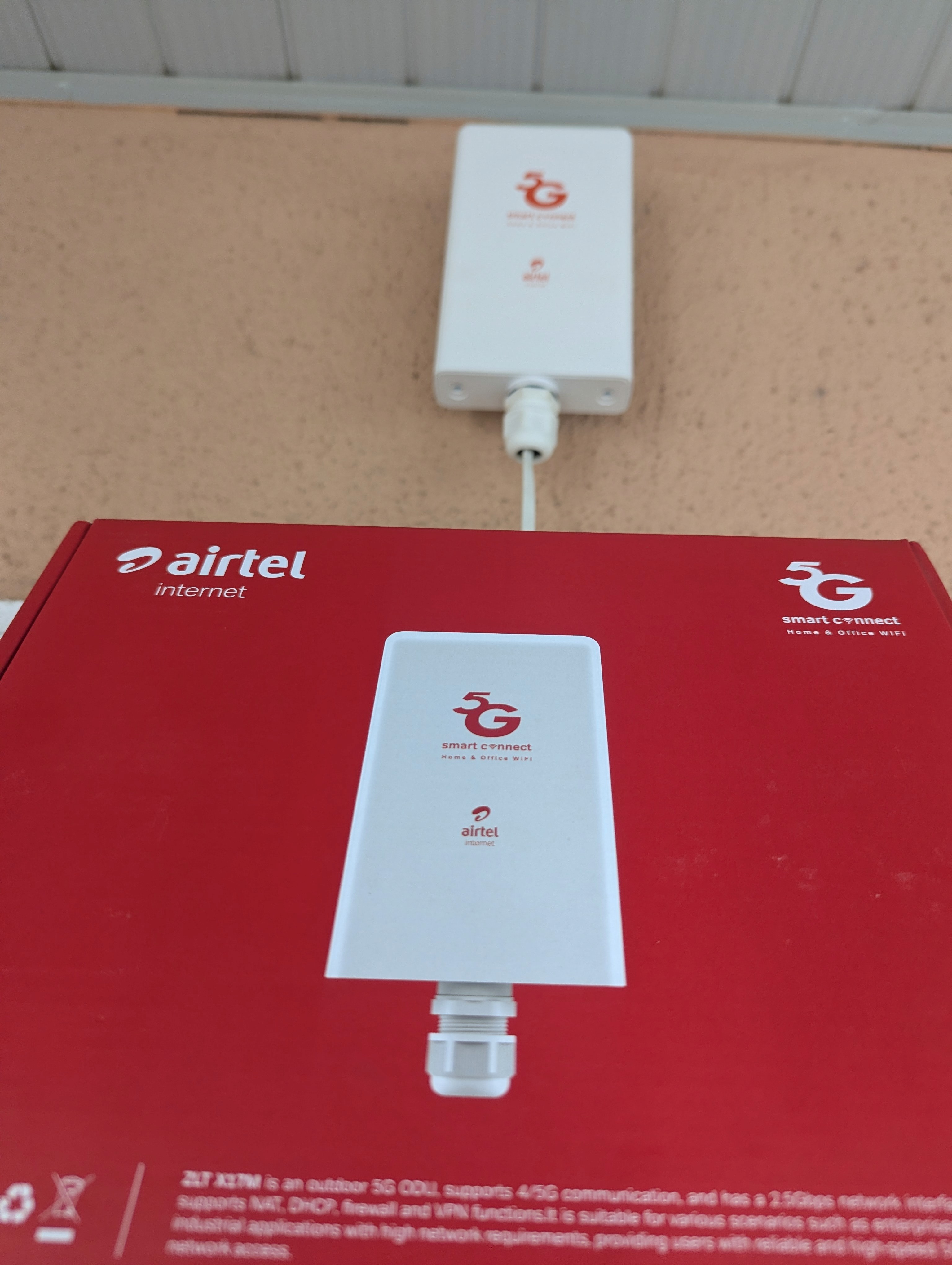
The ZLT X17M mounted and working, next to the box it came in. The outdoor unit is compact and does not look out of place once installed.
Getting It
The process is straightforward. Find an Airtel outlet that sells the ODU, drop your details (NIN, email, phone number, installation address), make your payment, and get your OTP and complete the process with the help of the sales staff.
When I bought mine it was 25,000 naira, installation inclusive. It is now 40,000 naira, they added a 15,000 naira installation fee recently. It comes with a free subscription of 50Mbps unlimited data plan for the first month, which is worth 25,000 naira.
After payment, Airtel assigns an installation agent to you. You get an email with their name and number before they visit, which is a thoughtful touch. For most people this part goes smoothly. For me it did not. The agent they paired me with was on the other side of Lagos, delayed several times, then eventually cancelled. But my experience does not represent the average. Everyone I know who got theirs around the same time had no such issues. Still, if you notice your assigned installer is unreasonably far or keeps pushing the visit, reach out to customer support early and ask for a reassignment. Do not just wait and hope.
The Installation process usually takes less than a week from purchase, with some users reporting next day installation. The installers are professional and they know what they are doing, but like anyone doing field work, they want to finish and move on. They will mount the outdoor unit where signal is strongest, but they will not go out of their way to make the cable routing neat unless you ask. If tidiness matters to you, say so before they start. And if you feel like tipping them at the end, they will not turn it down.
The Hardware
The full package comes with the outdoor unit, indoor unit, a cable connecting both, a small UPS battery, an ethernet cable, a power adapter, a user manual, and the bolts and brackets for mounting; everything you need is in the box. If you are a little technical, you should also be able to unmount and move the device yourself if you need to switch apartments at some point.
One thing Airtel does not make obvious is that there are at least three different hardware variants going around. Most people I know, myself included, got the ZLT X17M outdoor unit paired with the ZLT W304VA Pro indoor unit. Some people got the G5FA + MF296A combo, and there is a third variant I have seen only online. All variants have outdoor units that are dust and water resistant, so nothing to worry about once it is mounted outside. From what I have gathered, the ZLT X17M + ZLT W304VA Pro seems to be the better setup. If your installer shows up with an older model, you can ask them to come back with the newer variant. Whether that works out depends on the situation, but it is worth giving it a try.
What I want to be clear about though is this: the hardware is not really the determining factor here. What decides your experience is how strong Airtel’s network is in your area. The ODU is not a signal booster. It locks into whatever Airtel coverage exists on your street and delivers that to your home. If Airtel’s internet is weak where you live, the ODU will not perform miracles for you. The device is 5G capable, but for most areas in Nigeria right now, solid 4G is the best you’ll get.
The Network
I use the 25,000 naira “unlimited” data plan capped at 50 Mbps with a 1 TB fair usage policy. It’s worth noting that if you exhaust that 1 TB, your speed gets throttled by a ridiculous amount. My brother and I share the connection(with visiting friends connecting occasionally) and we have come close to that cap more than once, but I can confidently say that the plan is enough for a regular household. Just do not get too generous sharing with people outside your home. This might cause the fair usage policy to catch up with you faster than you expect, and the throttling when too many devices are connected at the same time is very noticeable.
There is a 100 Mbps plan at 45,000 naira. The case for it is if you have many heavy users on the same connection, or if you regularly do data-heavy tasks like uploading large video files. For the average person/household, the 25,000 plan is fine.
The 25,000 naira plan is genuinely one of the best value data subscriptions in Nigeria right now. For context, Airtel’s other 5G routers do not come with this kind of deal. Those devices get unlimited plans at N20,000 (up to 20 Mbps), N35,000 (up to 40 Mbps), and N50,000 (up to 60 Mbps). Compared to the ODU plans, it is clear Airtel is serious about pushing this product. If they keep this pricing, it will remain a compelling offer.
On the good days, and there are plenty of them, the speeds hold up well. You can see that from the screenshots. Browsing is fast, streaming works without drama, and you actually feel like you have reliable internet at home.
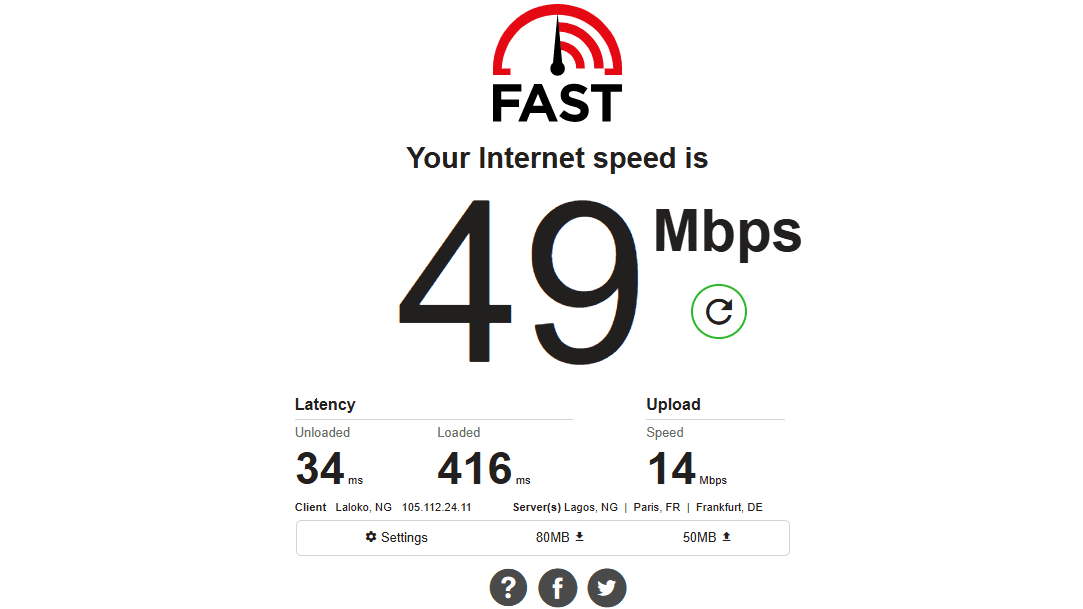
A good day. Nearly hitting the 50 Mbps cap on downloads. Upload at 14 Mbps is decent, though the loaded latency at 416ms is where things get tricky.
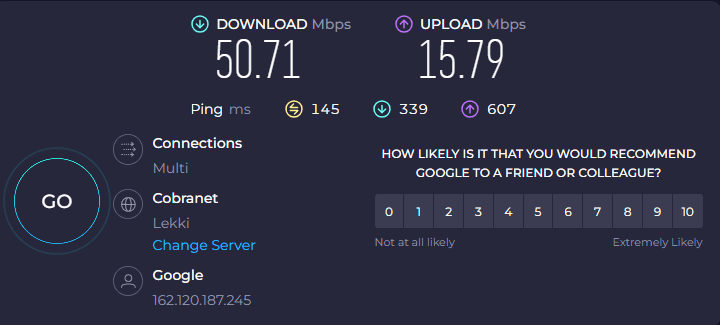
Another good day, this time on Speedtest. Download is at the cap, upload is solid at 15.79 Mbps. The ping though, 145ms on a good reading, tells you why real-time applications can still struggle
The problem areas are upload speed and latency, which can be inconsistent. I have struggled on video calls on days when everything looked fine on paper. I have also had issues gaming on Brawlhalla, which is not exactly a demanding game. So for competitive gaming, heavy downloads running alongside calls, or multiple people doing bandwidth-heavy things at the same time, this setup might frustrate you.
And then there are the bad days. Not slow internet. Not “manage it and move on” slow. I am talking double-digit Kbps. The kind of speed that makes you stare at your screen in genuine disbelief before accepting what is happening and switching to mobile data. Those days are not frequent, but they are real. They happen enough that you need to be prepared. I have endless snaps from friends complaining about their speeds, and you might have probably seen people on Twitter saying not so nice things about it too.

This tweet from @renny_theVA, which got over 3K likes & over 300k views, sums up what a lot of people go through on the bad days
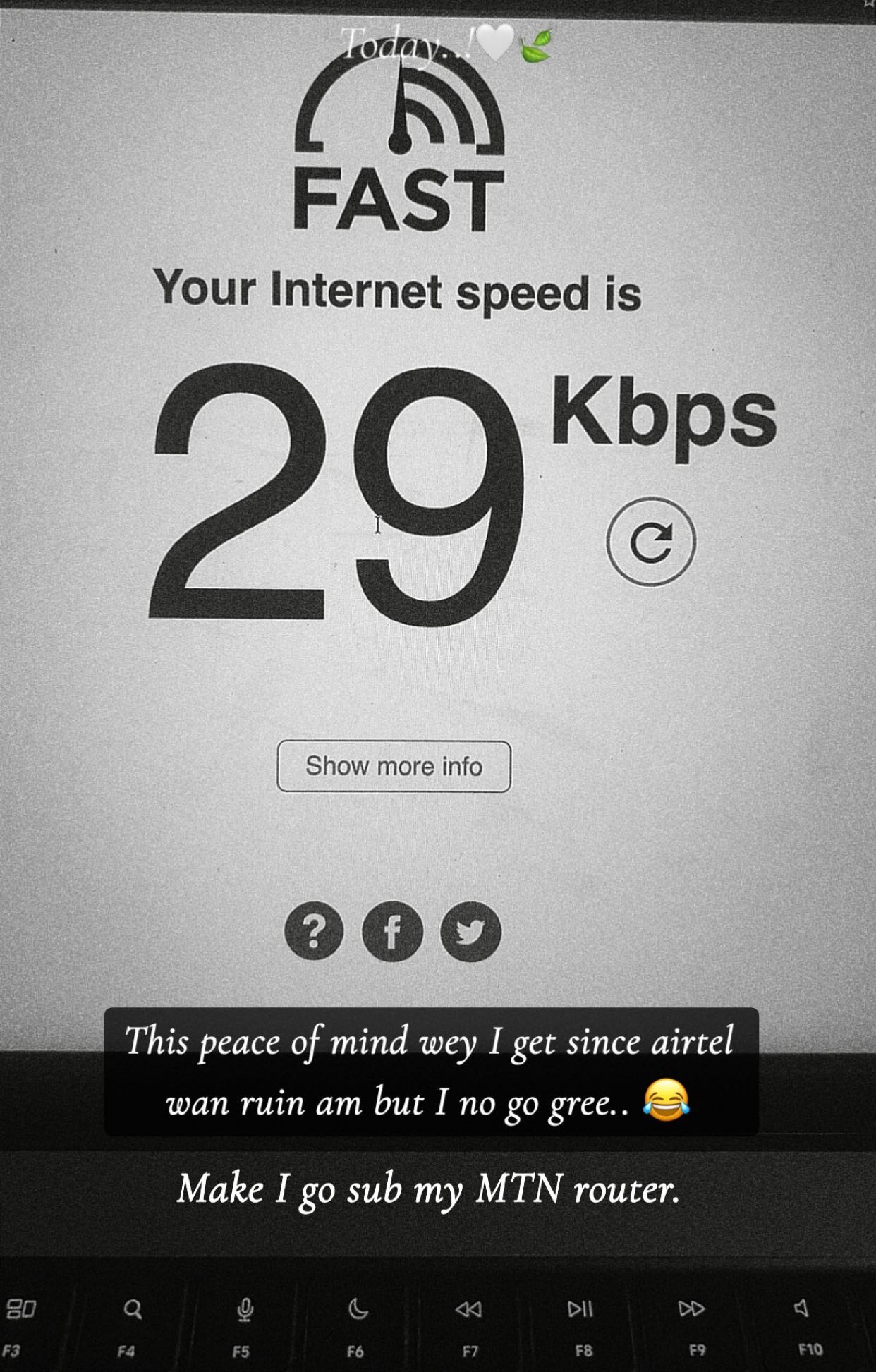
A bad day on the ODU. And nope, your eyes aren't playing tricks on you that is actually 29 Kbps
If you are going to survive the bad days without losing your mind, you will need a backup. A different network that performs well in your area, with enough data to carry you when the ODU lets you down, and when you are out of the house. This is not optional. It is just the reality of Nigerian internet in 2026.
Should You Get It?
It depends on where you live. If Airtel coverage in your area is strong, get it. The subscription value alone makes it worth serious consideration, and on its good days the experience is genuinely solid by Nigerian internet standards.
If Airtel coverage is weak in your area, look elsewhere. The hardware cannot fix that, and it will end up collecting dust. Consider a regular 5G router from the strongest network provider in your area, or Starlink if you can stretch the budget.
Unfortunately for you, but fortunately for Airtel, they are currently the only major network offering this kind of wireless fixed home internet product. MTN has FibreX, but that requires physical fibre cables laid to your home and is still limited to select areas. They are solving the same problem in very different ways, and for most Nigerians right now, the ODU is simply the more accessible option. It is not perfect, but it remains one of the more accessible wireless home internet options available in the country right now.
One more thing worth mentioning before you decide, power. The built-in battery is not a backup solution. It is just there to keep the device alive during brief outages. The one time I tested mine, it lasted just over three hours. If you live somewhere with genuinely stable electricity, that is fine. But if you are in a typical Nigerian neighbourhood where light comes and goes as it pleases, you need a plan. You can consider investing in a a dedicated UPS system that can give you some extra hours, I’ve come across some that promised 12 extra hours of usage, I run mine on solar so I have not had a reason to try these out. In any case, try to figure out your own arrangement before installation, not after.
Ideally we should not have to jump through this many hoops just to get reliable internet in 2026, but here we are. I hope this article makes the stressful decision a little easier.